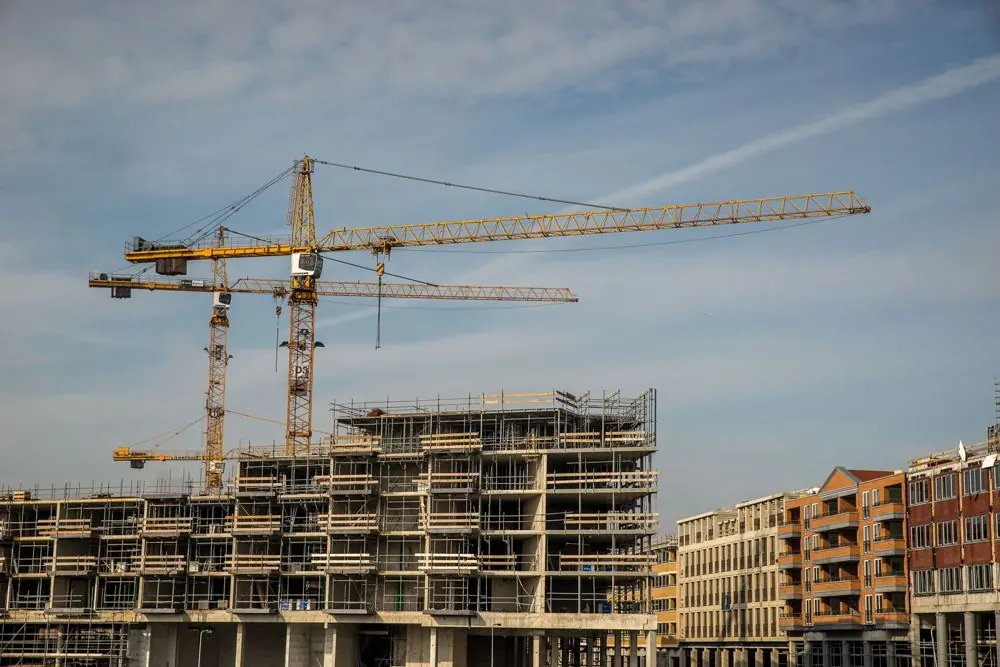
What Lenders Read in a Construction Schedule
Banks reported tighter standards for construction loans in the third quarter of 2026. The schedule of values and the project schedule are what a lender uses to judge whether a loan still has enough money and time in it.
In brief
Banks reported tighter standards for construction and land development loans in the Federal Reserve's October 2026 survey. A lender reads a schedule for one thing: whether the undisbursed loan balance covers the remaining cost and months, interest included.
Read transcript
Voice 1: What do lenders read in a construction schedule? The line under the headline answers it. A schedule is a promise about cash, as much as a plan for work.
Voice 2: The backdrop. In the Federal Reserve's October 2026 survey of senior loan officers, banks reported tightening standards, on net, for construction and land development loans.
Voice 1: And the pool is shrinking. Construction and development loans at insured banks stood at about 453 billion dollars in the second quarter of 2026, down from about 469 billion a year earlier.
Voice 2: A lender with less appetite reads every draw request harder.
Voice 1: So what is the lender actually asking?
Voice 2: One thing. Does the money not yet disbursed cover the remaining cost and the remaining months, interest included.
Voice 1: Which is why the article says, a slipped completion date is a budget event.
Voice 2: Right. The interest reserve was sized to a completion and lease-up date. If the date moves, the reserve runs short. And the commitments from the permanent lender carry their own dates.
Voice 1: Now the document every contractor knows. The schedule of values, the line-by-line breakdown of the contract sum that pay applications are billed against.
Voice 2: It is written by the party being paid, on a form with no standard line structure. That is where front-loading lives.
Voice 1: Meaning, billing more value early in the job than the work really represents.
Voice 2: Examiners are told to look for it. And banks pay consultants to reconcile the percent complete against what an inspector saw on site.
Voice 1: So there is a practical tip for contractors. If your line items map cleanly to the schedule activities, the bank's monitor has less to dispute.
Voice 2: Also, two different holdbacks can apply. The bank's own, which the examiner handbook describes as 10 to 20% in practice. And the retainage in the construction contract. They are separate.
Voice 1: One caution on the health numbers. The noncurrent rate on these loans, 0.92%, is from the end of 2025. It predates the tightening.
Voice 2: The full piece, with sources, is at fieldletterpress.com.
U.S. banks reported tightening standards, on net, for construction and land development loans and for the other commercial real estate categories in the Federal Reserve's October 2026 senior loan officer survey, which covers the third quarter8. Construction and development loans at FDIC-insured institutions stood at $453.5 billion in the second quarter of 2026, down from $469.2 billion a year earlier7.
A lender with less appetite reads every draw request harder, and what it reads is the contractor's paperwork. The schedule of values and the project schedule are the evidence a bank uses to decide whether the loan still has enough money and time left in it. The lender asks one thing of a schedule: whether the undisbursed balance covers the remaining cost and the remaining months, interest included. On that reading, a completion date that slips is a budget event.
The OCC's Comptroller's Handbook booklet on Commercial Real Estate Lending (version 2.0, March 2022) sets out what national bank examiners expect. Under "Construction Plans and Budget" (pp. 33 to 34), a reviewer confirms that the budget and schedule realistically reflect the cost and time to build. The booklet says budgets usually carry a contingency of roughly 5 to 10% of the total, that a developer fee typically does not exceed 4% of project cost, that developer profit should not be funded before completion, and that general conditions should be funded with each advance, not up front1.
| Item | Benchmark | Source |
|---|---|---|
| Contingency | Roughly 5 to 10% of total budget | OCC handbook1 |
| Developer fee | Typically no more than 4% of project cost | OCC handbook1 |
| Holdback on each progress payment | Typically 10 to 20% | OCC handbook1 |
| Borrower capital in before the bank advances funds | At least 15% of "as completed" appraised value | 12 U.S.C. 1831bb3 |
| Supervisory loan-to-value limit, commercial and multifamily construction | 80% | OCC handbook1 |
The handbook figures describe typical practice that examiners expect to see; they are not lending limits. The 15% figure is a statutory condition for avoiding the heightened risk weight. Source: Office of the Comptroller of the Currency; Legal Information Institute, Cornell Law School.
How a draw is built
Draws run on the contractor's paperwork. AIA Document G702-1992 is the contractor's application and the architect's certificate in one form, reporting work completed and stored to date, retainage, previous payments, change orders and the current request5. G703-1992 breaks the contract sum into portions of the work according to a schedule of values the contractor prepares, and the AIA publishes no standard schedule of values form6. On the bank side, the handbook's progress payment plan (p. 50) releases funds by completed phase with a holdback of typically 10 to 20% of each payment, requires subcontractor and supplier lien waivers with draws, and conditions the final draw on waivers, a final inspection and a certificate of occupancy. Title should be updated with each draw (p. 49)1.
The schedule of values is written by the party being paid, on a form with no standard line structure6. That is where front-loading lives, which explains why examiners are told to look for it and why banks pay consultants to reconcile percent complete against what an inspector saw12. A contractor whose line items map cleanly to the schedule activities gives the monitor less to dispute.
The handbook's 10 to 20% holdback is described as bank practice, and it is separate from the retainage line a contractor reports on G702, which the construction contract sets15. Where both apply, the contractor, the borrower and the bank each have a different view of how much cash should trail the work.
Where schedule meets cash
Monitoring is where schedule meets cash. The handbook (pp. 46 to 48) expects inspection reports from an architect or engineer with each draw, an independent construction consultant where the bank lacks in-house expertise, and monthly reports on work completed, cost to date, cost to complete and deadlines1. The FDIC's Construction and Land Development Lending examination module (October 2025) tells examiners to test for front-loading, meaning overstated early-stage costs (procedure 15), to confirm the undisbursed balance can finish the project (procedure 16), and to check that inspections are independent and precede draws (procedure 19)2. On interest reserves, the OCC says a reserve should cover interest through completion and lease-up or sale, and that refilling a depleted reserve with new debt is a red flag (pp. 7 to 8)1. FDIC procedures 23 and 24 require realistic completion and lease-up timeframes and a feasibility review behind any extension2.
Delay costs a lender in three places that the documents name. The interest reserve was sized to a completion and lease-up date1. Takeout commitments carry dates that the FDIC module wants aligned with the construction loan (procedure 11)2. The loan cannot be reclassified out of HVCRE ADC status until construction is substantially complete3. The borrower's 15% stays locked in for the same period.
The capital rules behind the loan
Capital rules sit behind the loan agreement. Under 12 U.S.C. 1831bb, a commercial construction loan escapes the heightened risk weight for HVCRE ADC exposures under the statute's commercial-project exclusion if loan-to-value is within the supervisory limit and the borrower has put in capital equal to at least 15% of the "as completed" appraised value before the bank advances funds. That capital must stay in until reclassification, which needs substantial completion and cash flow that supports debt service3. The supervisory loan-to-value limit for commercial and multifamily construction is 80%1. The 2006 interagency guidance (71 FR 74580) flags a bank for closer review when construction and land loans reach 100% of total capital, and says the criteria are not lending limits4.
The asset-quality numbers are dated. The 0.92% noncurrent rate is from year-end 2025 and predates the tightening reported for the third quarter of 202689. The July 2026 survey had described construction loan standards as basically unchanged, with a moderate net share of banks reporting weaker demand10. The October survey page gives no net percentages, and the FDIC's second-quarter 2026 loan tables were not available for this piece.
The FDIC's third-quarter 2026 Quarterly Banking Profile will show where the noncurrent rate on construction and development loans stands against 0.92% at year-end 20259. The Federal Reserve's next quarterly survey will show whether the net tightening reported in October continues. The OCC's Commercial Real Estate Lending booklet, version 2.0 of March 2022, was last amended in March 2025 by OCC Bulletin 2025-4.
Know someone who should read this?
Send it to your development or finance partner. Practical pieces like this one travel fastest from one practitioner to another.
Get the next one in your inbox
The Brief on Tuesdays and Field Note on Fridays, with Real Estate stories first. About five minutes each.
Read a sample issue before you sign up. One click to unsubscribe. Privacy notice. Edited by a team with more than 90 years combined in AEC business development, civil engineering and construction surety.
Updated November 15, 2026. This piece is now credited to the Real Estate Desk rather than a named desk byline, a short summary was added at the top, and the publication date was corrected to November 14, 2026, the day it first appeared on this site. Standards and corrections.
Sources
- Comptroller's Handbook: Commercial Real Estate Lending, Version 2.0Office of the Comptroller of the Currency · March 2022 · primary source · read in part
- Construction and Land Development Lending, Core Analysis Procedures (Examination Modules 10/25)Federal Deposit Insurance Corporation · October 2025 · primary source
- 12 U.S.C. 1831bb, Capital requirements for certain acquisition, development, or construction loansLegal Information Institute, Cornell Law School · date not shown · primary source
- Concentrations in Commercial Real Estate Lending, Sound Risk Management Practices, 71 FR 74580OCC, Federal Reserve Board and FDIC (Federal Register) · December 12, 2006 · primary source
- Summary: G702-1992, Application and Certificate for PaymentAIA Contract Documents · date not shown · primary source
- Summary: G703-1992, Continuation SheetAIA Contract Documents · date not shown · primary source
- Balance Sheet: Total Assets: Loans Secured by Real Estate: Construction and Development (QBPBSTASLNREALCONDEV)Federal Reserve Bank of St. Louis (FRED), source FDIC · August 27, 2026 · primary source
- The October 2026 Senior Loan Officer Opinion Survey on Bank Lending PracticesBoard of Governors of the Federal Reserve System · November 2, 2026 · primary source
- Quarterly Banking Profile, Fourth Quarter 2025Federal Deposit Insurance Corporation · date not shown · primary source · read in part
- The July 2026 Senior Loan Officer Opinion Survey on Bank Lending PracticesBoard of Governors of the Federal Reserve System · August 3, 2026 · primary source
Credited to the Field Letter Press Real Estate Desk, a desk credit rather than a named reporter. This piece was researched and drafted with AI assistance, and each claim was checked against the sources listed above by a separate reviewer. Field Letter Press did not interview anyone for it. How we work · Report an error